


CBIES AUTOMOTIVE|Body Structure And Connection With Hidden Iron Frame
The body is mainly composed of sheet metal and sheet metal, and there are curved pipes in the A-pillar and B-pillar of some car bodies, with different shapes, as if pipes are added to the body structure. What kind of process is this? What are the characteristics of this design? And how is the closed tube connected to the bodywork?
What process is the pipe produced by?
Among the various tubing processes, hydroforming is the ideal process for making closed tubular parts. Hydroforming refers to a plastic processing technology that uses liquid and molds to shape workpieces.

Hydroforming technology uses seamless pipe fittings or welded pipe fittings as raw materials, relies on liquid as the force transmission medium, adopts precise control of internal pressure and axial feed material, cooperates with mold cavity, and finally makes the metal hollow blank form an integrated complex shape. Manufacturing technology of cross-sectional members.
CBIES AUTOMOTIVE has been deeply involved in the auto parts industry for decades. Seamless pipes and welded pipes are our main business. side beam impact tubes, exhaust pipes, seat pipes, etc. are relatively popular. The sales of torsion bars in coated pipes are also well received by customers. unanimous praise.
The main feature of pipe hydroforming technology is that it can realize the integral molding of hollow parts with special-shaped cross-sections with two-dimensional or three-dimensional curved axes. From the initial circular cross-section tube blanks, it can be formed into elliptical, trapezoidal, rectangular, or other complex curved surfaces and closures with variable cross-sections. section.
Traditional stamping and welding generally cannot obtain a complete closed section of the part, and the stamping part has restrictions on the length and cross-sectional shape of the part.
Hydroforming technology is mainly used in the A, B, and C pillar areas of the body, and these areas are parts that are highly related to the safety and performance of the body:
A. Reduce quality and save materials. Hydroformed parts are 20% to 40% lighter than stamped parts;
B. Reduce the number of parts and molds, and reduce the cost of molds. Hydroformed parts usually only need one set of molds, while most stamping parts need multiple sets of molds;
Reduce the amount of welding required for subsequent machining and assembly;
C. Improve strength and stiffness, especially fatigue strength;
D. Reduce production costs. According to the statistical analysis of applied hydroformed parts, the production cost of hydroformed parts is 15%-20% lower than that of stamping parts on average, and the mold cost is reduced by 20%-30%.

connection details
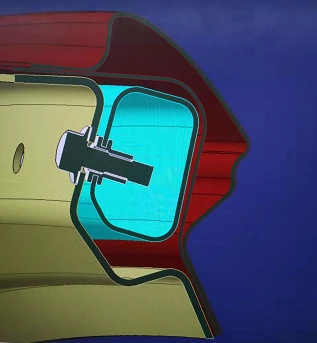
How does the closed pipe connect with other parts of the body? The difficulty of connecting tubular parts and peripheral parts is that the cross-section is closed and only one side is accessible.

Connection method 1:
Open a hole to let the welding torch pass through for spot welding. It is usually used in places where the strength requirement is not particularly high.
Connection method 2:
Pre-drill holes in the pipe for the rivet nut, and then screw the body sheet metal and the pipe.

Connection method 3:
The process of connecting can be realized on one side is applied. The pipe is connected to the inner plate FDS in advance, and attention should be paid to the welding level.
Connection method 4: Then use laser welding (here refers to laser fusion welding) to complete the welding. Laser welding only needs to reach one side to weld.
When the body structure is at a mature stage of lightweight and performance development, new processes or new materials must be required to achieve further development of the body, and new processes may bring new challenges to the connection. However, the hot press forming process In the application of the body, the lightweight and performance of the body has been improved to a higher level.